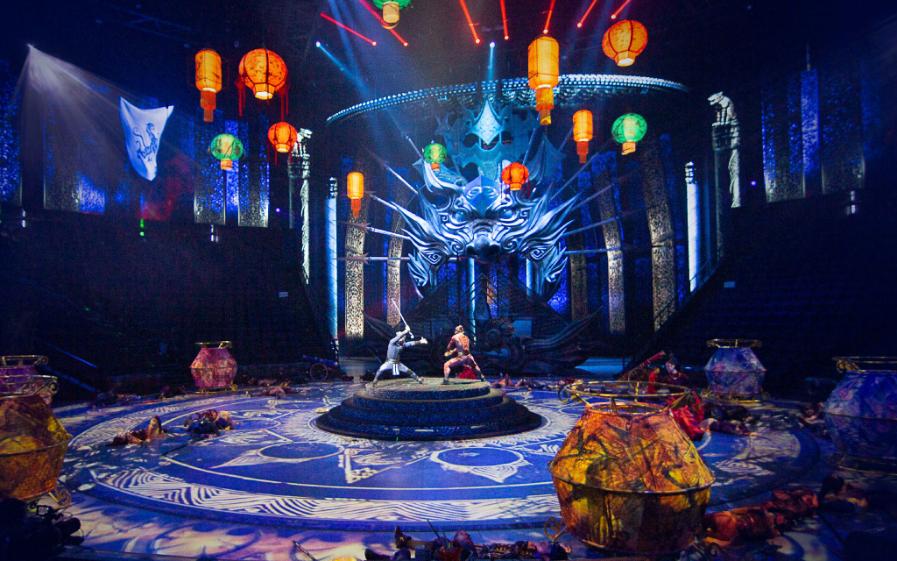
Some of the most interesting moments in live work happen when the set itself moves. A stage that revolves. A structure that rises. A chandelier that opens overhead. When the scenery becomes part of the choreography, the engineering brief gets a lot harder — and it's the part of the craft I keep coming back to.
When the architecture performs
On Splendor, the Taihu Show in Wuxi, Dragone's materials credit me as "Kinetic & Set Designer." It was built around a revolving centre stage, a tilting and rotating lift, and a roughly 9.5-metre 360-degree LED surface. On Terhal in Diriyah, a kinetic chandelier of three concentric LED rings hangs above a 36-metre stage and does as much storytelling as anything on the ground. In both, the motion is the show — not a flourish on top of it.

Engineering as design
Designing kinetic scenery means thinking like an engineer as much as a designer. Every moving element has to be precise, repeatable and safe — every night, with no margin. Weight, balance, sightlines, reset time all become part of the creative decision. The illusion only holds if the mechanics are invisible. When something fights something else — a sightline against a counterweight, a piece of choreography against a reset cue — you find out fast.

Why I keep coming back to it
Kinetic design is the place where the engineers and the designers have to actually agree. The scenery isn't a backdrop. It's a machine the show runs on, and that's the part of the work that interests me most.