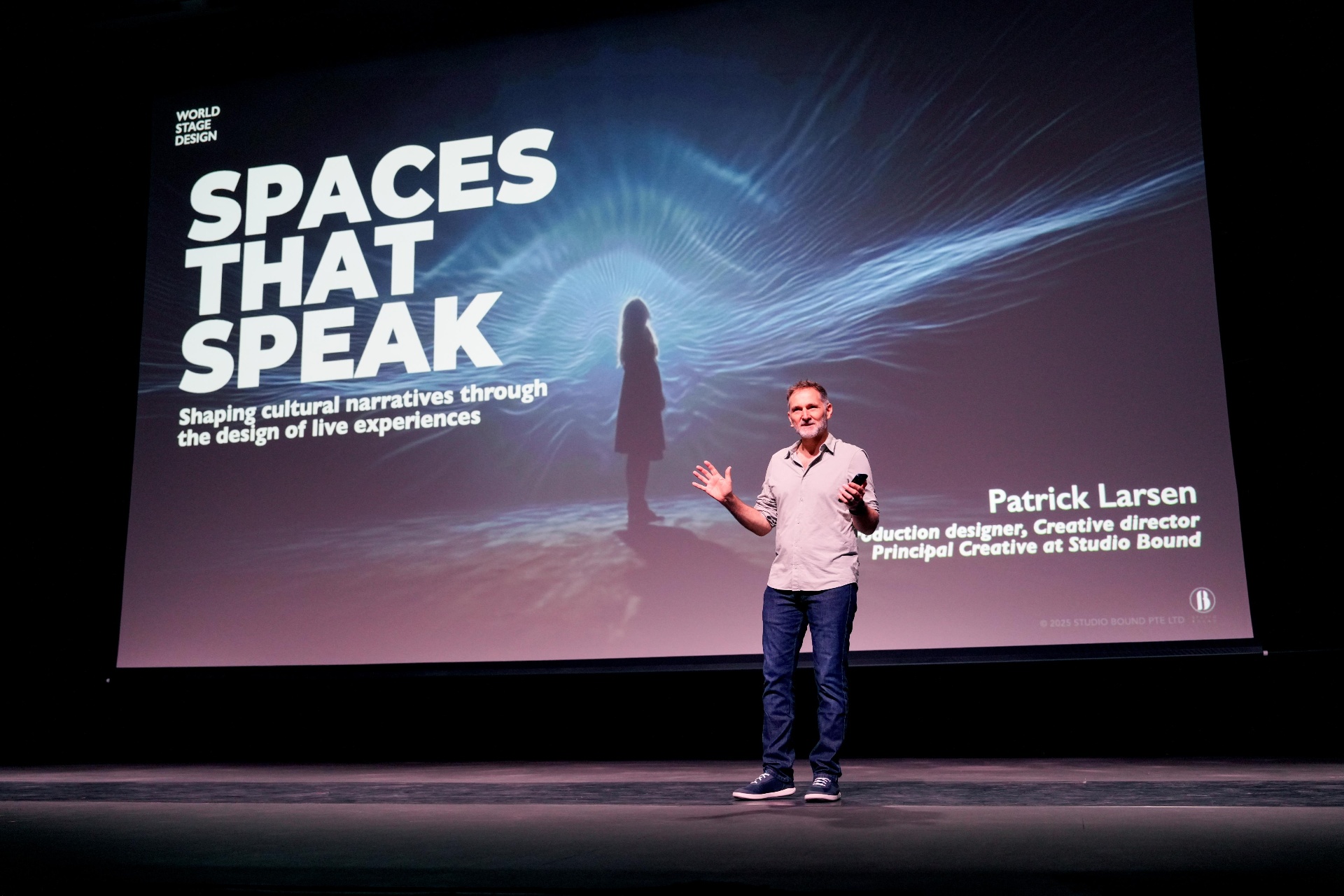
Last October I was asked to give a keynote at World Stage Design in Sharjah. I called it Spaces That Speak: Shaping cultural narratives through the design of live experiences, and I spoke on 19 October in the Main Theatre at the Sharjah Performing Arts Academy.
For anyone who doesn't know it: World Stage Design is the international exhibition of performance design. The 2025 edition was co-produced by the Sharjah Performing Arts Academy and OISTAT, ran from 18 to 25 October, and was the first time the event had been hosted by an Arab city. I was one of two keynote speakers on the programme, which I still find slightly improbable.
This is roughly what I said, and why.
I started with work that wasn't mine
That was on purpose. The audience were scenographers, theatre architects, lighting and costume designers — people who build this for a living and can see exactly how every effect is done. Standing in front of that room showing my own portfolio would have been the least useful thing available to me.
So I put up other people's work instead. The temple at Burning Man, raised in a desert by volunteers and burned on purpose a week later. What the Paris team managed in 2024, using a whole city and its river as the venue. Rihanna's Super Bowl performance, which solved a similar problem by taking almost everything away. The Eurovision stage, which is as much engineering as design.
What I wanted the room to notice wasn't the scale. It was that none of these people were talking to each other. Different continents, different traditions, different money, different reasons — and the same instinct every time. Build something far larger than it needs to be. Gather people inside it. Give them one thing to feel together.
Peter Brook wrote that in theatre, empty space isn't a void — it's a canvas. Start there and this stops looking like an industry and starts looking like something older.
Why I don't call it entertainment
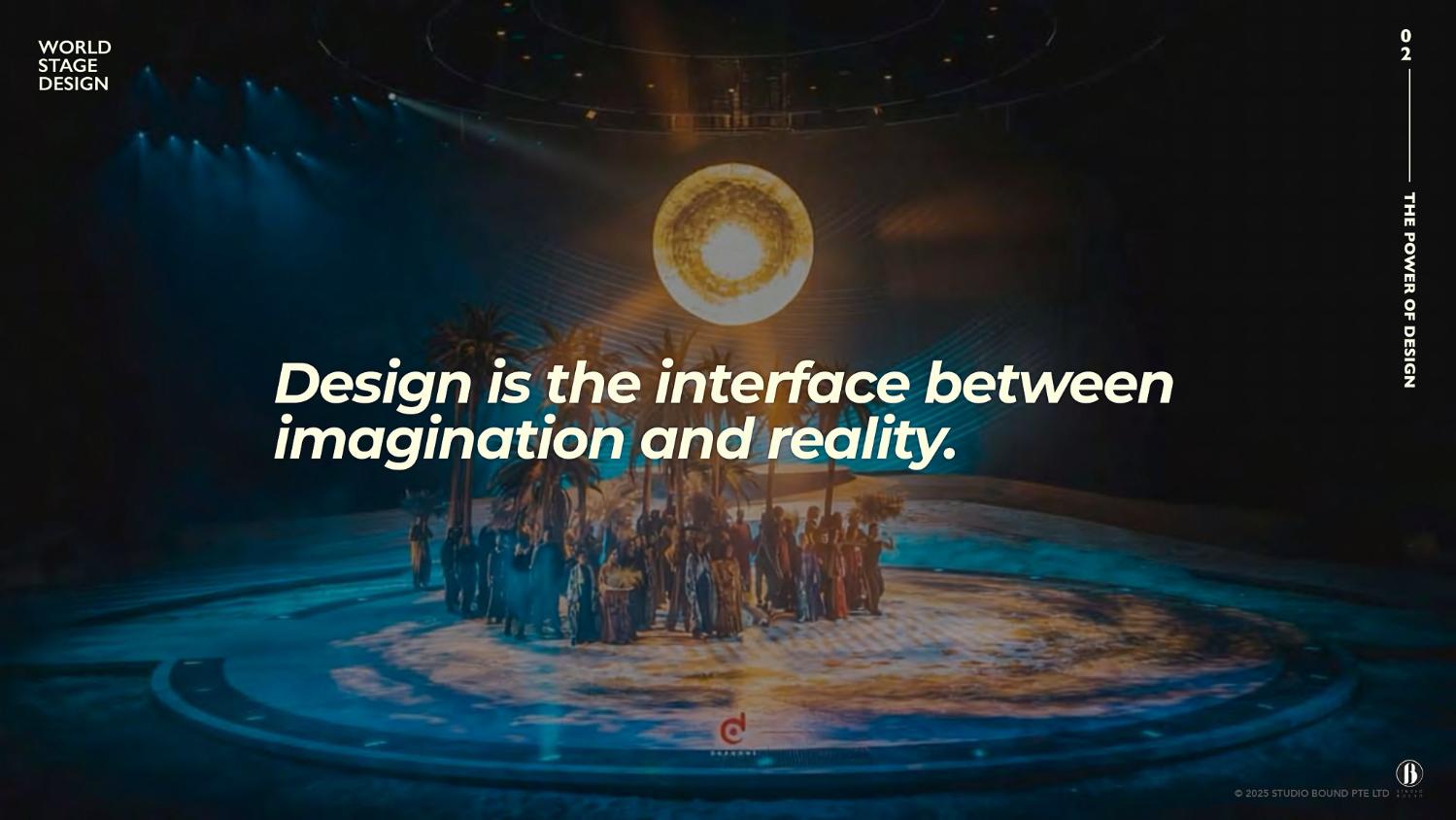
Design is more than a visual or functional discipline. It's a cultural tool that shapes the stories we live by — and the things we build are not just entertainment. They're rituals. They're memory. They're identity. They're futures imagined in real time.
I realise how that sounds written down. I mean it quite practically. When a few thousand people go quiet at the same second, something has happened that "a show" doesn't quite cover.
The part I actually came to say
Here's my worry about images like the ones I opened with, and it's why I showed them.
Looking at work of that quality, most people reach for the word genius — a gift issued to a few at birth. I think that's wrong, and I think it quietly damages young designers, who tend to conclude around nineteen that they weren't one of the lucky ones.
I've spent twenty-five years around work built at this scale. I have never seen the lightning bolt. Not once.
What I've seen is far duller and far more encouraging. People collect more raw material than they can possibly use. They sit with it well past the point of comfort. They spend weeks apparently achieving nothing. Then, usually at an unhelpful hour, the real idea turns up underneath the ten obvious ones — and they throw away most of what they'd already made in order to protect it.
That's not inspiration. That's a process, run patiently, by people who are tired.
It reads as magic from outside only because the finished moment is the part that gets published. The long middle isn't photographed by anyone.
Which is the good news, and the reason I bothered giving the talk. If wonder is a gift, there's nothing to be done about it. If it's a method, you can learn it, run it on days you feel entirely uninspired, and get better at it across a career.
Design as a language
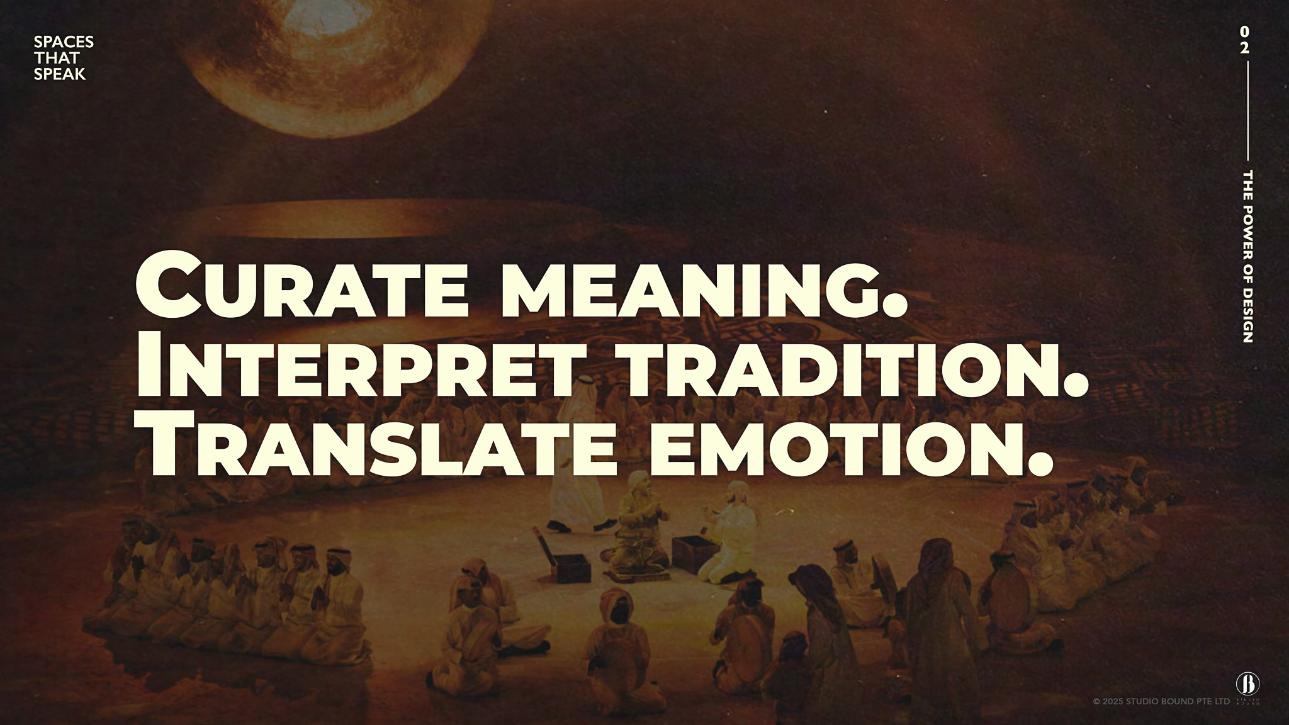
A narrative space is where design, imagery and atmosphere come together to invite people into a journey. Three verbs do most of that work:
Curate meaning — decide what the evening is about before deciding what it looks like. Everything downstream obeys that choice.
Interpret tradition — a lot of my work sits inside a culture that isn't mine. Interpreting a tradition means asking the people who hold it what it means, then finding a form a stranger can feel too. Decorating with it instead is how you end up making a costume party out of somebody's inheritance. I treat that as a responsibility rather than a matter of taste.
Translate emotion — a feeling exists in someone's head, and the job is to move it into steel, fabric and light without dropping it.
Creating spectacle: principles and responsibilities
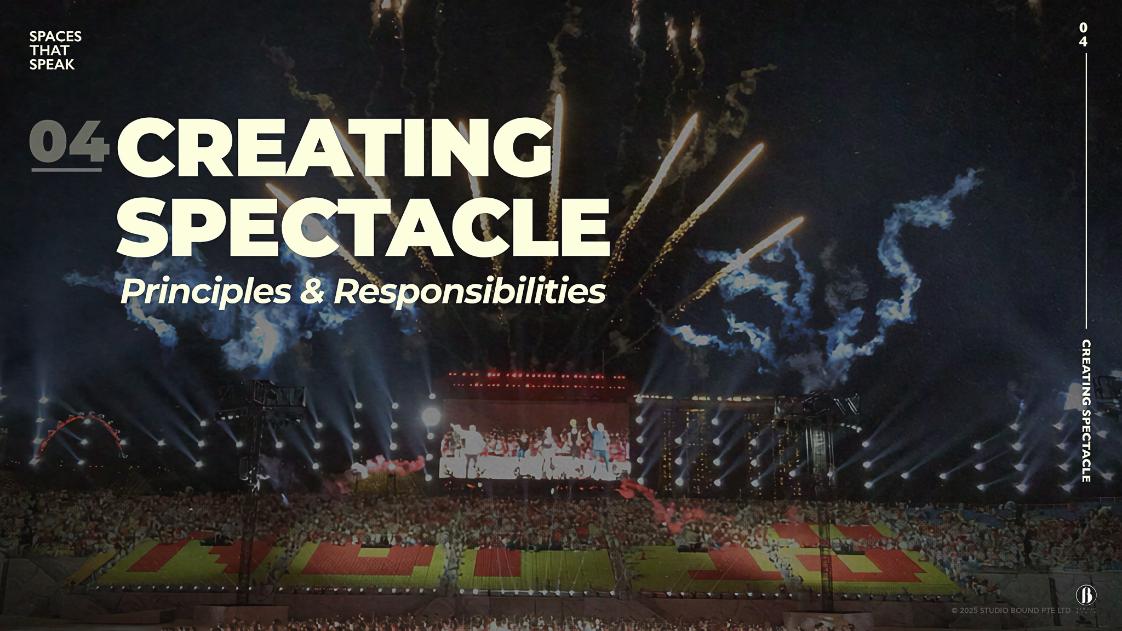
How the work actually gets made:
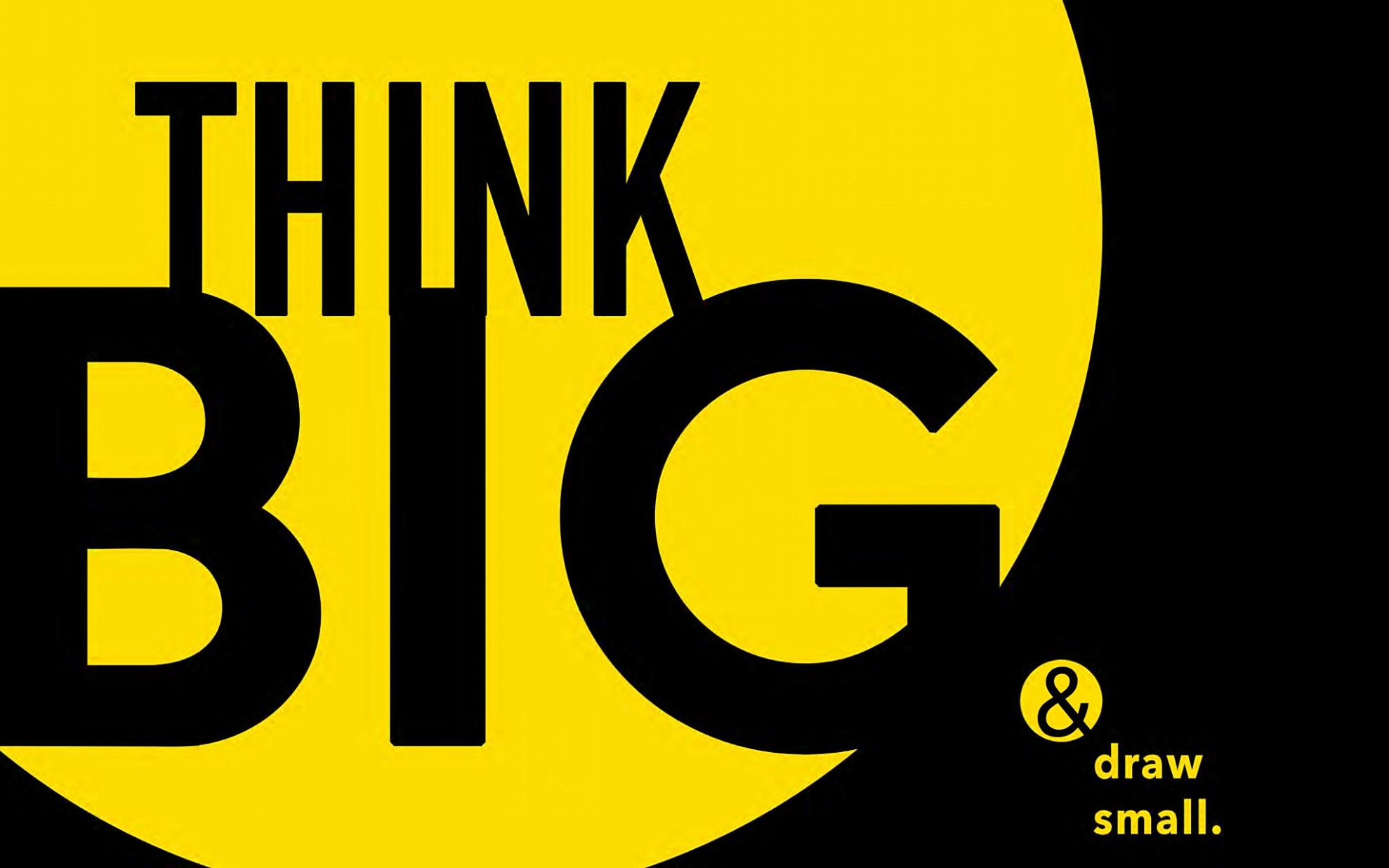
- Think big and draw small — hold an ambitious idea, then make the next decision as small and specific as you can.
- Take risks — calculated ones — an opening night doesn't move, and you can't patch it on Tuesday. Know which risk you're running.
- Focus on process, not product — the product has too many hands on it. The process is yours.
- Design is never the voice of one — it is a chorus — I've never made anything of any size alone, and pretending otherwise only makes the work worse.
And the line I'd keep if I could only keep one: the designer does not command the space, they converse with it. Space offers opportunity, the designer offers imagination and vision, and together they make meaning rather than objects. I've watched confident people try to impose a vision on a venue and get quietly beaten by the room. It always has an opinion.