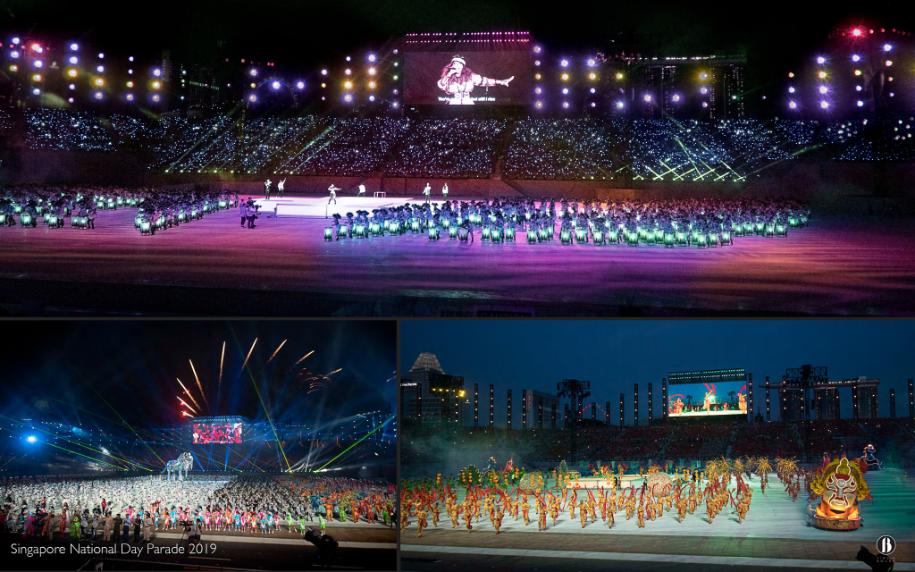
The Singapore National Day Parade is a nation's annual celebration of its own independence and identity, staged for a live audience and broadcast to the country. At Studio Bound we provided the production design for the 2019 edition at The Padang — a project defined less by scale than by responsibility, because the subject was the identity of a people I don't belong to.
Study the people, not the aesthetics
I approach cross-cultural work of this kind through a single distinction: study the people, not the aesthetics. Treating a culture as a set of visual motifs — colours, patterns, forms to be collected and arranged — produces work that looks respectful while understanding nothing. The more useful and more demanding path is to understand what a community is actually proud of, and how it relates to its own story, before any visual decision gets made.
Fixed constraints and interpretive ones
Some constraints are fixed and straightforward: the parade's palette is red and white, non-negotiable, drawn from the national flag. The harder part is interpretive — grasping how a young and multicultural country sees itself, which no amount of visual research will hand you.
Three kinds of attention
The principle I lean on here separates three kinds of attention: to form and function, to light and emotion, and to people. When a project belongs to a community, the last of those governs the rest — the forms follow from understanding the people, and no amount of surface polish makes up for getting that understanding wrong.