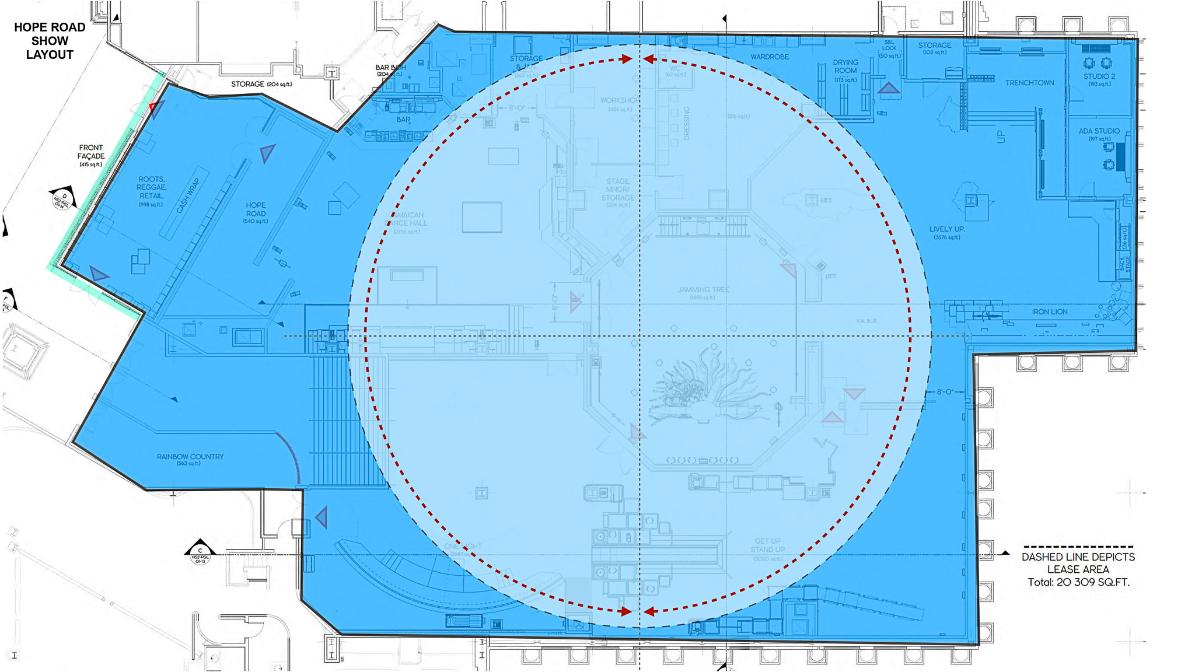
Bob Marley Hope Road, which opened at Mandalay Bay in Las Vegas in 2025, takes its audience through seven themed rooms across roughly ninety minutes. It's named after 56 Hope Road in Kingston — Marley's home and studio — and at Studio Bound we designed its full scenographic environment: the spatial architecture, the material language, and the design framework tying all seven rooms together, including the sculptural "Jamming Tree" at its centre.
The design began, as many do, with the most obvious idea — and got better only once we let that idea go.
The biography was the wrong structure
The obvious structure for a show about a life is a biography: rooms as chapters, arranged chronologically. It reads clearly and it honours the subject. But a timeline explains a person; it doesn't reproduce the feeling of them — so we designed the experience around the music rather than the life story.
The rooms became moods rather than dates, and the sequence followed the emotional logic of the songs rather than the order of events in Marley's life.
Specificity before universality
The principle I keep returning to is specificity before universality: begin with the exact and particular — Kingston, Trenchtown, the specific streets — and let the universal feeling emerge from it, rather than starting broad.
Choosing that structure over the more obvious one is a discipline the design field shares with writing, where the instruction to "kill your darlings" describes exactly this: being willing to give up the more familiar idea in order to reach the one that's actually right.